The crack spread, cut down to one page
$47.05 a barrel. That's what the 3-2-1 crack spread came to on the closing prices of the first week of November 2026, and it's the number at the top of a one-page guide I've just put up.
Why one page? The full article on refinery margins covers hedging, the trouble with crude quality and the trouble with location. Someone in their first week on an energy desk wants less than that before lunch. The formula, one worked example and the seasonal shape will do.
The sum is short. Gasoline (RBOB) closed the week at $2.7227 a gallon, diesel (ULSD) at $4.1983 and crude (WTI) at $87.96 a barrel. Multiply the product prices by 42 to turn gallons into barrels: two barrels of gasoline come to $228.71 and one of diesel to $176.33. Take away three barrels of crude, $263.88, and you're left with $141.16. Divide by three for the margin on each barrel of crude.
For scale: across five years of weekly prices, starting November 2021, the average was $32.80. Its low was $14.60, in September 2024. Its high was $75.30, in the last week of August 2026.
The rest of the page is the calendar.
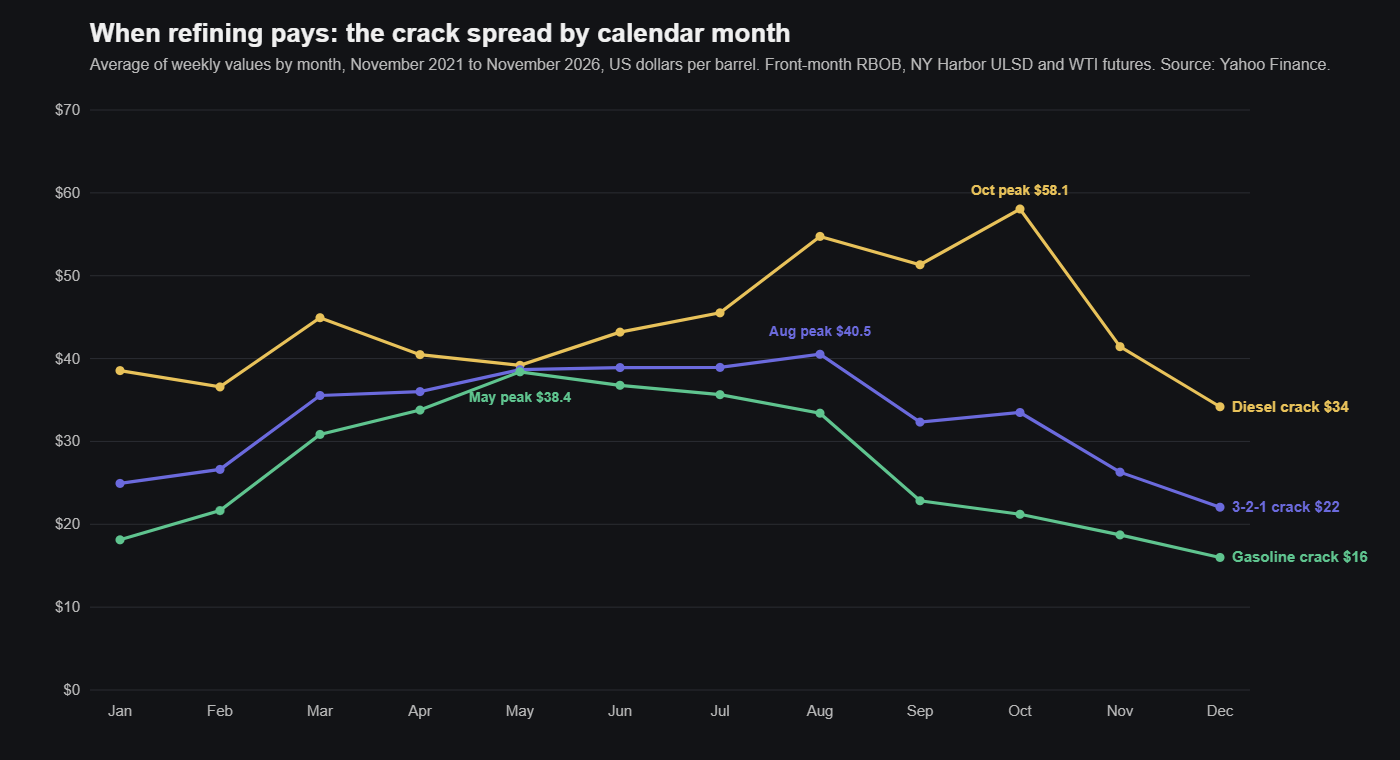
Average weekly crack spreads by calendar month, November 2021 to November 2026.
Gasoline and diesel earn their best margins in different seasons. Gasoline's best month is May, averaging $38.40, and its worst is December at $16.00. For diesel it's October, $58.10 against $34.20. Blend the two and the 3-2-1 is strongest in August ($40.50) and weakest in December ($22.10). Five years of weekly prices is a short sample, so I'd trust the shape of that chart more than the cents.
Some things didn't fit on the page. The crack is a gross margin, before the refinery pays for energy, catalysts, staff and the plant itself. It assumes WTI, a light sweet crude delivered in Oklahoma, and products priced in New York Harbor, and a refinery that buys a different crude or sells somewhere else earns a different margin. Those gaps, and the futures hedge a refiner uses to lock in a margin, are in the article.
The guide, free to download, is on SlideOrbit: slideorbit.com/Caio1
The full article: How refinery margins work: the 3-2-1 crack spread explained
The 2:54 video version is on YouTube.
Comments
Post a Comment